- CliniciansOur team of expert, down-to-earth providers
- ServicesOur curated care options
- AboutThe people and story behind USP
- InformationInsurance and policies for patients
- InsightsThe latest news and posts from our team
How We Treat → TMS – Transcranial Magnetic Stimulation
TMS, or Transcranial Magnetic Stimulation, is a drug-free, painless, non-invasive form of neuromodulation used for treating a variety of psychiatric disorders, including depression and OCD. TMS is a rapidly growing treatment option for patients who have seen little success from other forms of neuropsychiatric treatment, including psychotherapy and medication therapy.
How does TMS work?
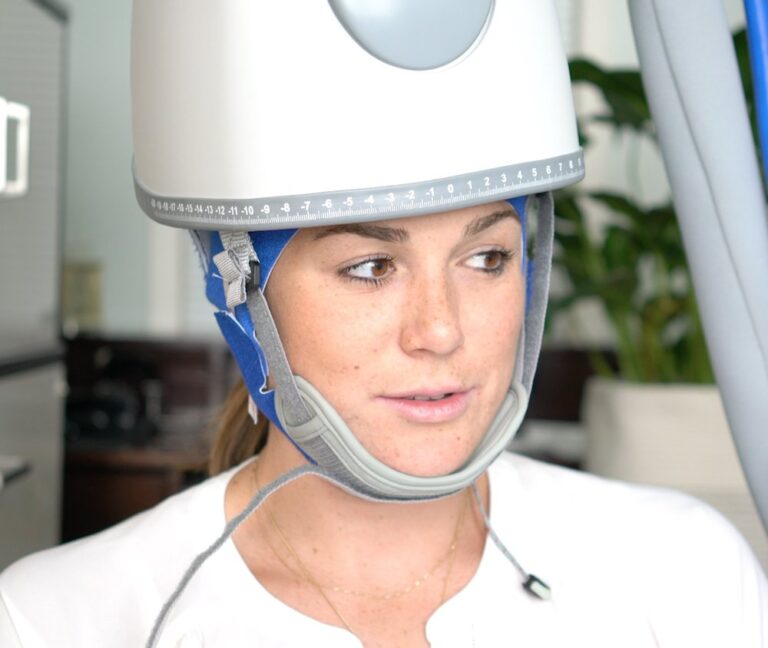
TMS works by stimulating specific areas of the brain that are critical in repairing and protecting against a number of psychiatric symptoms, including those most closely associated with severe depression. To achieve this effect, TMS sends a series of electric currents through conductive wires of an insulated helmet to induce a local magnetic field. These currents, sent in rapid succession, then travel transcranially to induce a secondary electric current in a predetermined part of the brain.
As the TMS pulses arrive, the underlying part of the brain that is being targeted stays activated longer. When this intervention is used daily, these effects can last weeks, months, or longer. Additionally, the effect of TMS is not limited to the brain area being stimulated, but includes the neural network of structures connected to that site, which generally results in greater overall therapeutic potential.
Are there different types of TMS?
Yes, there are different types of TMS modalities. One type of TMS treatment is known as repetitive transcranial magnetic stimulation (rTMS), during which brief magnetic pulses are delivered repetitively at varying frequencies. A second form of TMS treatment, deep transcranial magnetic stimulation (dTMS), works in very much the same way as rTMS, but can send electric currents significantly deeper into the brain. This is advantageous because research has shown that deeper prefrontal areas of the brain are more closely linked to the impaired functioning that is seen in depression and other psychiatric disorders.
What type(s) of TMS do we offer at USP?
At USP, we offer deep TMS as part of the Brainsway TMS system, which has been FDA-approved for the use of deep TMS for both treatment-resistant depression and Obsessive Compulsive Disorder (OCD). Deep TMS has also been used to effectively treat several other conditions ranging from anxiety to ADHD to smoking cessation.
TMS therapy may be right for you if you’ve tried multiple forms of antidepressants (2-4 different types) and psychotherapy with little or no improvement. If curious, please consult your doctor to discuss the possibility of TMS as a treatment option. Please also call or contact us to talk more about your suitability for TMS.
Your first session of TMS will involve a technician taking measurements for your personal TMS cap and asking questions pertaining to your health. After the measurements are done, the technician will take a motor threshold (MT). The MT is used to determine the intensity of your treatment. After preparations are done, you will be seated in a comfortable chair and have the option to engage in some form of entertainment of your choice (phone, books, etc). The TMS helmet will then be placed against your head and treatment will begin.
Some patients report that the pulses feel like someone “tapping” on their head. The treatment will continue to run for its prescribed time, after which the technician will remove the helmet and your cap and you will be free to continue your day. All subsequent treatments follow this format.
There are no special instructions following a TMS session. Since TMS does not require anesthesia or any form of sedation, you are completely fine to immediately carry on with your day as you normally would. However, it is very important to keep your clinician informed of any alcohol or recreational drug use, as this can impact treatment. Your clinician will review this during the evaluation and subsequently at all TMS sessions.
Your first session of TMS will last about 60 minutes: 20-30 minutes of preparation and 20-30 minutes of actual treatment. Subsequent sessions will be streamlined and should typically last 20 minutes, though the length of your session may vary depending on the treatment plan and the specific conditions being treated.
In order for treatment to be effective, we ask patients to be available 5 days a week (3 days minimum) for at least 6 weeks. A full TMS course of treatment consists of 36 treatments, with the final 6 treatments spaced out over several weeks.
After you complete your 36 treatments, a follow-up appointment will be scheduled with our psychiatric team. They will evaluate and interpret the data gathered during the treatments with you. Depending on how effective the treatment was, some patients may return for “touch-up” TMS treatments every few weeks or months. If TMS was ineffective, other options will be discussed, such as a change in medication or alternative therapies.
TMS therapy has very mild side effects. The most common side effect of TMS therapy includes facial twitching and scalp discomfort during treatment. These twitches occur only during treatment and do not continue after a TMS session. Other patients sometimes report a mild headache or some mild discomfort at the application site. These discomforts can be mitigated with a mild over-the-counter pain reliever, such as Tylenol or Advil.
As with any medical treatment or therapy, we cannot guarantee results. Still, TMS therapy has very few side effects compared to antidepressants and should definitely be considered before pursuing more intensive treatments such as Electroconvulsive Therapy (ECT), which has moderate to severe side effects. Ongoing research has shown that at least 50% of TMS patients have experienced significant improvement in their symptoms after a full TMS course of treatment.
Most major commercial insurance companies (e.g., United Healthcare, Cigna, Aetna, BCBS) will cover TMS treatment. However, The Center for Cognitive Brain Health at USP is out-of-network with most insurance companies. This means that you will need out-of-network benefits if you want insurance to cover TMS. The basic criteria to qualify for insurance coverage is:
AND
It is important to note that other insurance companies can be very meticulous when assessing coverage for TMS therapy. If our clinicians think you are a potential candidate for TMS, we will contact your insurance company to verify that they will cover your TMS treatment. Coverage varies per insurance company and it can take some time to receive approval. As a result, we suggest making an appointment as soon as possible in order to put the process in motion.
OCD was FDA-approved in 2018, but most insurance companies have yet to offer coverage as it currently stands. Other treatable conditions, such as anxiety, PTSD, and smoking cessation, are considered “off-label” treatments, meaning it has not yet been FDA-approved. As a result, insurance companies will often not cover treatment for these conditions. The one workaround for off-label treatment is to pay out-of-pocket, which would bypass insurance guidelines.
The first step is to contact us to say you’re interested in TMS therapy. One of our Clinical Coordinators will take down your insurance information and a detailed history to help determine if you are eligible for TMS treatment. If you satisfy the criteria, you will be scheduled for a TMS evaluation with one of our senior clinicians. This evaluation will decide whether or not the treatment is right for you at this time. If the evaluating clinician thinks that you are a good candidate, we will contact your insurance company to verify coverage and to take care of any prior authorizations. After we receive clearance from your insurance, we can schedule your first TMS appointment!
Union Square Practice is a group of psychologists, psychiatrists and therapists who empower individuals to be the best versions of themselves using the latest science has to offer.
Reach out to us using any of the contacts below or our general contact form.